Why is dry mode the right air conditioning setting for an empty home in a Dubai summer?
Dry mode. Dehumidification happens only while the compressor runs and the coil sits below the dew point, and dry mode reduces fan speed so more water condenses per hour of running. A high setpoint satisfies the thermostat early and stops the compressor, which stops moisture removal entirely. Where a system has no dry mode, 24–25°C is the practical alternative.
Key facts
-
Dry mode removes more moisture per hour of operation than a standard cooling setting.
Lower air velocity raises dehumidification capacity, mainly by reducing air bypass. Measured on a chilled-water fan coil; reverses below about 2 m/s.
-
A compressor that is not running removes no moisture from the air.
Condensation requires a coil surface below the dew point, which only occurs while the compressor operates.
-
Where no dry mode exists, a setpoint of 24–25°C keeps the system cycling often enough to dehumidify.
Reasoned from compressor run-time requirements. We have not measured the optimum for this climate.
-
Fan-only operation can return water from the coil and drain pan into the room.
With the compressor off the coil warms above the dew point while the fan continues moving air across standing condensate.
Why does a high temperature setting fail to protect an empty home?
A high setpoint fails because dehumidification is a function of compressor run time, not of the temperature reached. The thermostat is satisfied quickly, the compressor cycles off, and moisture removal stops while the room still reads as adequately cool.
Dry mode works on the opposite principle. Fan speed is deliberately reduced so that air spends longer in contact with the cold coil, which increases the proportion of the system's work spent removing water rather than lowering temperature.
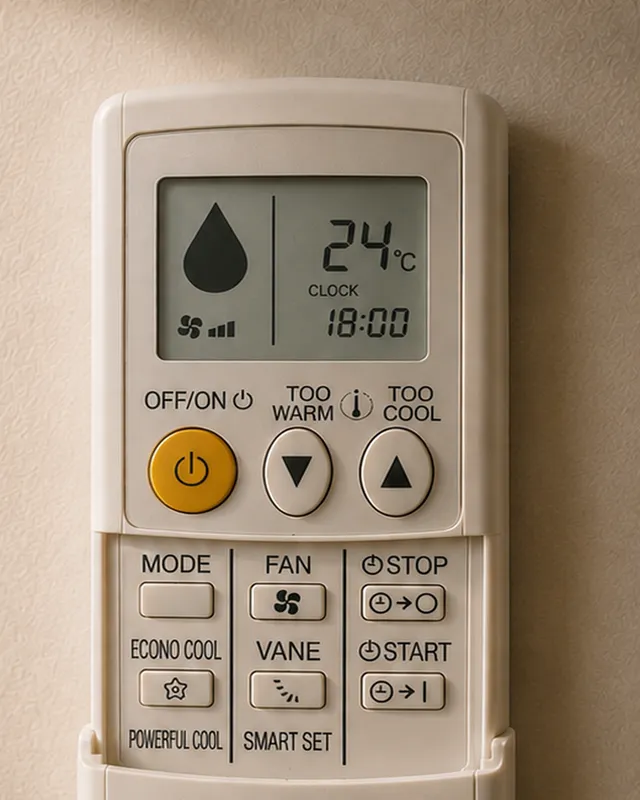
What if the air conditioning system has no dry mode?
Many air conditioning installations in Dubai villas offer only cool, fan and off, particularly where a central thermostat controls fan coil units. Where that is the case, set 24–25°C rather than higher. The objective is enough compressor run time to dehumidify.
The change can be made remotely by anyone with access to the property, which matters because the question usually occurs to people after they have already travelled.

Why should fan-only mode be avoided?
Fan-only operation moves humid air around a building without removing any moisture from it. Worse, once the compressor stops the evaporator coil warms above the dew point of the air crossing it, and air moving over residual condensate on the coil and in the drain pan can carry that moisture back into the room.
Set an air conditioner before leaving a Dubai home empty in summer
- Find dry modePress MODE on the controller until a water droplet icon appears. The mode may be labelled DRY or DEHUMIDIFY.
- If there is no dry mode, set 24–25°CWhere the system offers only cool, fan and off, set 24–25°C. Do not set higher to save energy — it reduces moisture removal.
- Never leave the system on fan onlyFan-only circulates humid air without removing moisture and can return water from the coil into the room.
Definitions
- Dry mode
- An air conditioner mode prioritising moisture removal over cooling, typically by reducing fan speed. Labelled DRY or DEHUMIDIFY, usually marked with a water droplet icon.
- Latent heat removal
- The share of an air conditioner's work that removes water vapour from air rather than lowering its temperature.
- Dew point
- The temperature at which air becomes saturated and water vapour begins to condense. Any surface below it collects liquid water.
What we are sure of, and what we are not
Established
- Dehumidification occurs only while the compressor runs and the coil is below the dew point.
- Lower air velocity across a coil raises dehumidification capacity, mainly by reducing air bypass.
- Fan-only operation performs no dehumidification and can return coil water to the room.
Estimated by us
- 24–25°C as the alternative setpoint. Reasoned from run-time requirements rather than measured for this climate and building stock.
Not known
- The proportion of Dubai air conditioning installations that offer a dry mode.
- The optimal setpoint for an unoccupied Dubai home, which to our knowledge has not been established empirically.
- Whether the 2 m/s optimum, measured on a chilled-water fan coil, applies to the DX split systems where dry mode is usually found.
References
Chuah YK, Hung CC, Tseng PC. Experiments on the Dehumidification Performance of a Finned Tube Heat Exchanger. HVAC&R Research. 1998;4(2):167–178. doi:10.1080/10789669.1998.10391398 Dehumidification capacity rises as air velocity falls, attributed to reduced air bypass. Non-monotonic — the effect reverses below about 2 m/s. Chilled-water fan coil, three rows.
Shirey DB, Henderson HI, Raustad RA. Understanding the Dehumidification Performance of Air-Conditioning Equipment at Part-Load Conditions. US Department of Energy. 2006. doi:10.2172/881342 Source for the fan-only claim and for poor dehumidification under short-cycling.
About Gaia Solutions
We measure indoor air in Dubai homes and buildings, treat it with plant-based products, and tend it four times a year. Where we show our own data we state how many rooms, over what period, and with what coverage; our devices are factory-calibrated and we hold no individual calibration certificates, so we publish the shape of a change rather than an absolute concentration judged against a limit.
support@gaia-solutions.earth · +971 56 374 2421 · References & limits →